


European mobility for everyone
The European Civic Service: 6 months at home, then 6 months elsewhere in Europe
A two-step volunteering pathway that opens European mobility to all young people, including those who have never travelled abroad. Since 2020, more than 1,000 young people have experienced it in our SCE cohorts.

1 000+
young people in SCE cohorts since 2020
3 000
young people engaged in our projects
43
cohorts deployed across Europe
22
countries in the network
200+
active partners: associations, public administrations, local authorities
How does the European Civic Service work?
The idea is simple: you start by volunteering at home, surrounded by young people from all over Europe, then you go abroad in turn. The pathway is co-funded by the European Union and the Member States.
1
Open recruitment
No diploma or language requirements. Every cohort includes at least 50% young people with fewer opportunities.
2
6 months at home, in a European team
A civic service mission in your own country, in a cohort made up of 50% young people from that country and 50% young people from elsewhere in Europe. Language classes and training on Europe included.
3
6 months or more of mobility
The young person then joins a cohort in the country of their choice, through the European Solidarity Corps or a civic service scheme.
4
Support after the programme
Recognition of the skills acquired, and guidance towards employment, further studies or another European programme.
Why a European civic service?
The European Solidarity Corps offers around 50,000 volunteering placements a year, for an age group of 4.7 million young Europeans. Demand already exceeds supply three times over, and these programmes mainly reach the most highly educated and best-informed young people.
Our proposal: build on the national civic services that already exist in France, Italy or Germany, and connect them to the European Solidarity Corps. These schemes already host eight times more young people. A first step at home provides the time and the framework to prepare for departure, including language learning.
The facts in figures
- 50,000 volunteering placements a year in the European Solidarity Corps
- 4.7 M young Europeans in one age group
- ×3 applications exceed available placements
- ×8 more young people already hosted by national civic services
5 years in the field, a milestone every year
Since the first cohort in Metz, every year has brought European recognition or new pilots, often both.
2020
The first cohort, in Metz
- September: with Unis-Cité, 24 young people from France, Germany, Italy and Belgium launch the first European Civic Service. The 12 French volunteers then spend 6 months in Italy.
- 25 November: official launch, chaired by the French Secretary of State for Youth, in the presence of the European Commission and the French Civic Service Agency.
2021
The Charlemagne Prize and support from the Élysée
- 3 October: the Collective receives the European Parliament’s Charlemagne Youth Prize, a first for a French organisation.
- New cohorts in France and first partners in Italy and Germany.
- 9 December: the French President announces the ambition of a European civic service for all, a priority of the French Presidency of the EU Council.
2022
A European recommendation
- 5 April: the Council of the EU unanimously adopts a recommendation calling for a civic service in every Member State, connected to European instruments.
- 3 June: 100 volunteers gather at the European Parliament in Strasbourg, together, for the first time, with the French, German and Italian national civic service agencies.
- New cohorts in Malta, where a national civic service is created, then in Italy, Romania and Austria.
2023
Génération Europe and the Brussels declaration
- 29 January: for the 60th anniversary of the Élysée Treaty, the founder and the president of the Collective join the “Génération Europe” cohort, received by Emmanuel Macron and Olaf Scholz.
- 29 March: at the European Parliament, the declaration “Towards youth mobility and youth engagement for all” is presented, backed by 60 organisations from 18 Member States.
- Launch of the international civic service “Our youth, our best ambassadors”. 232 young people in SCE cohorts.
2024
Pilots expand, the Paris Olympics
- Civic service pilots in countries that do not yet have one: Bosnia and Herzegovina (Sarajevo), Romania (Timișoara), Poland (Kielce, Warsaw, Gdynia), Spain (Madrid) and Portugal (Cascais).
- Summer: during the Paris Olympics, our volunteers organise the first International Youth Forum for Peace (300 young people from around 100 countries, under the auspices of UNESCO) and a European Olympic carnival with 5,000 participants.
- Pope Francis receives our volunteers and blesses the European Civic Service. 423 young people in SCE cohorts in the first half of the year.
2025
5 years of action in the field
- End of the YouSCE pilots in Portugal, Poland, Romania and Spain, followed by new cohorts in Málaga and Mělník (Czechia).
- Launch of the Ukraine mission: mixed teams of French, European, local and Ukrainian refugee youth in Romania, Poland and Czechia.
- October: Gdańsk conference on the results of YouSCE. Year total: 218 young people in 15 countries.
2026
The Balkans, the Winter Olympics and the 5th anniversary meeting
- January: launch of BEYOND, the first pilot civic service in the Western Balkans (Albania, Bosnia and Herzegovina, Montenegro, Serbia), and of GreenLink in Bologna, Cannes, Budapest and Málaga.
- New cohorts in Cyprus, Hungary, Latvia and Frankfurt (Oder). The only organisation deploying civic service volunteers at the Milano Cortina Winter Olympics.
- In Aachen, the Collective, which chairs the network of former Charlemagne Prize laureates, congratulates Mario Draghi, 2026 laureate.
- Annual meeting for the European Civic Service’s 5th anniversary →
Mobility that is truly open to all
54,6 %
young people with fewer opportunities in our cohorts in 2025, against a minimum target of 50%.
21 %
of 2025 volunteers had no diploma; 50.8% had a secondary school diploma, 28.2% a bachelor’s or master’s degree.
Young people with fewer opportunities are those facing obstacles linked to education, social or economic situation, disability, a migrant background or belonging to a minority, or geographical isolation (rural areas or deprived suburbs).
What young people gain
92 %
recommend the experience
94 %
feel like European citizens at the end of the programme
87 %
have gained autonomy and initiative
74 → 12 %
share of beginners in their new language, before and after (self-assessment)
One month after their cohort
- 38.5% are in employment
- 27.3% are in training or studies
- 12.1% continue in another programme
- 11.8% are looking for work
- 10.3% are pursuing another project
The most developed skills
- 91% intercultural openness
- 87% autonomy
- 84% teamwork
- 82% adaptability
- 78% communication
Source: follow-up of young people after their SCE cohort, carried out with our partner organisations (2025 cohorts).
“Living with these young people from all over Europe and serving the common good, it’s the first time I truly feel European.”
Maxime, 24, SCE cohort in Metz then mission in Milan · Read all testimonials
Where does the European Civic Service take place?
In 2025, 218 young people took part in an SCE cohort in 15 countries. Combining late 2025 and the first half of 2026, that is 374 young people, with new cohorts in Cyprus, Hungary, Latvia, Montenegro, Serbia and Albania.
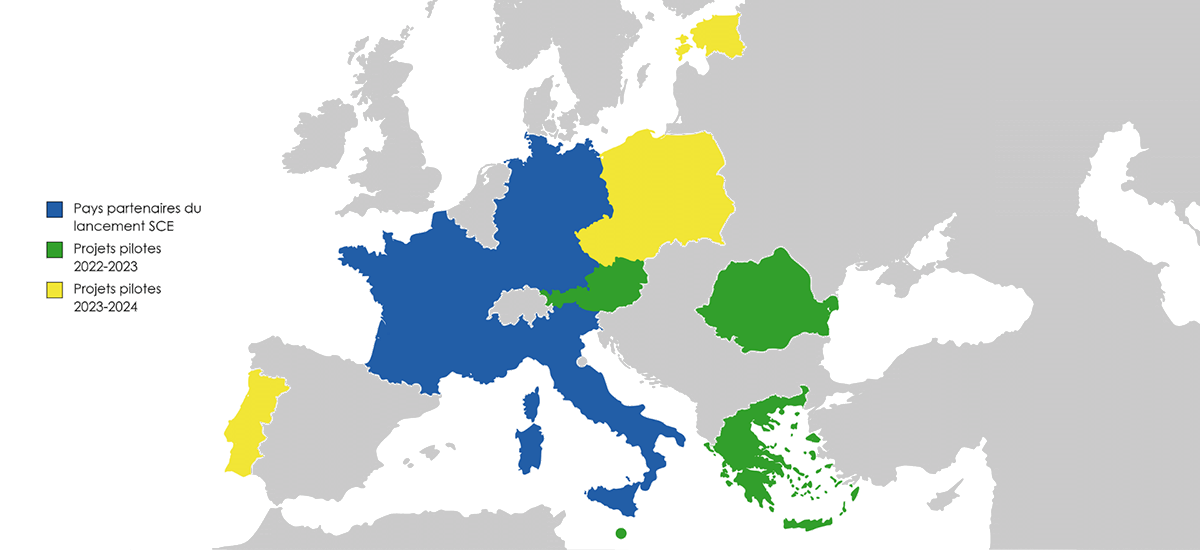
Current or recent cohorts: France (Dunkirk, Caen, Saint-Étienne, Carcassonne, Angers, Cannes), Spain (Madrid, Málaga), Portugal (Cascais), Italy (Bologna), Malta (Valletta), Germany (Frankfurt (Oder)), Poland (Gdynia, Warsaw, Lublin), Czechia (Mělník), Romania (Bucharest), Hungary (Budapest), Latvia (Riga), Cyprus (Nicosia, Larnaca), Bosnia and Herzegovina (Sarajevo), Montenegro, Serbia, Albania.
Our programmes
The heart of the scheme
SCE cohorts
Mixed cohorts of local and European young people, in France with Unis-Cité and across the network: 6 months at home, then 6 months of mobility.
Young people aged 18 to 25 living in France
International civic service
“Our youth, our best ambassadors”: 6 to 10-month missions in the French cultural network in Europe. 15 host organisations in 12 countries, including the Milano Cortina 2026 Winter Olympics.
Western Balkans · since January 2026
BEYOND
Coordinated by the Collective with 7 partners in Albania, Bosnia and Herzegovina, Montenegro and Serbia, BEYOND offers 85 young people a civic service mission in their own country, followed by mobility or support towards employment.
Romania, Poland, Czechia · 2025-2027
Solidarity with Ukraine
Teams made up of one quarter French, one quarter other European, one quarter local and one quarter Ukrainian refugee youth, working together to support refugee families. Target: 400 young volunteers.
Frequently asked questions
Who can take part in the European Civic Service?
Young people aged 16 to 30, depending on the country and the scheme. In France, civic service is open from 16 to 25, and up to 30 for young people with disabilities. No diploma is required: only motivation counts.
Do I need to speak a foreign language already?
No. The first step, at home in a European team, is precisely there for learning. Language classes are offered before departure.
How long does the pathway last?
6 months of mission in your own country, then 6 months or more of mobility in another European country.
Is there an allowance?
Yes. Volunteers receive the allowance provided by the national scheme (in France, the civic service allowance), then the European Solidarity Corps allowance during mobility. The programme is free for young people.
Our organisation would like to host a cohort: how do we proceed?
Associations, local authorities and institutions can join the network. Write to us at info@service-civique-europeen.com: we will support you in designing the missions and finding funding.
Ready to experience Europe differently?
Discover the open missions, or join the network as a host organisation.
Figures: the Collective’s 2025 activity report · updated October 2026